Dry salt bounces. A brine film on the grain makes it stay where the spreader put it — which is the whole argument, and it is a measurable one.

A dry salt grain hitting a dry road at speed skips. Some of it reaches the gutter, some of it reaches the verge, and the part that stays is the part you paid for.
Wet the grain first and it adheres on contact. The same truck carrying the same tonnage covers more useful road, which is why pre-wetting is one of the few winter maintenance changes that shows up in a budget rather than only in a specification.
There are two ways to get there: buy a pre-wetted blend, or spray liquid onto dry salt as it leaves the spreader. The second is more common in fleets that already have the tanks.
Applied 24–48 hours before a forecast event, liquid stops snow bonding to the surface in the first place. A road that has been pre-treated clears faster and needs less granular product during the event. Many authorities run both: anti-icing before, pre-wetting during.
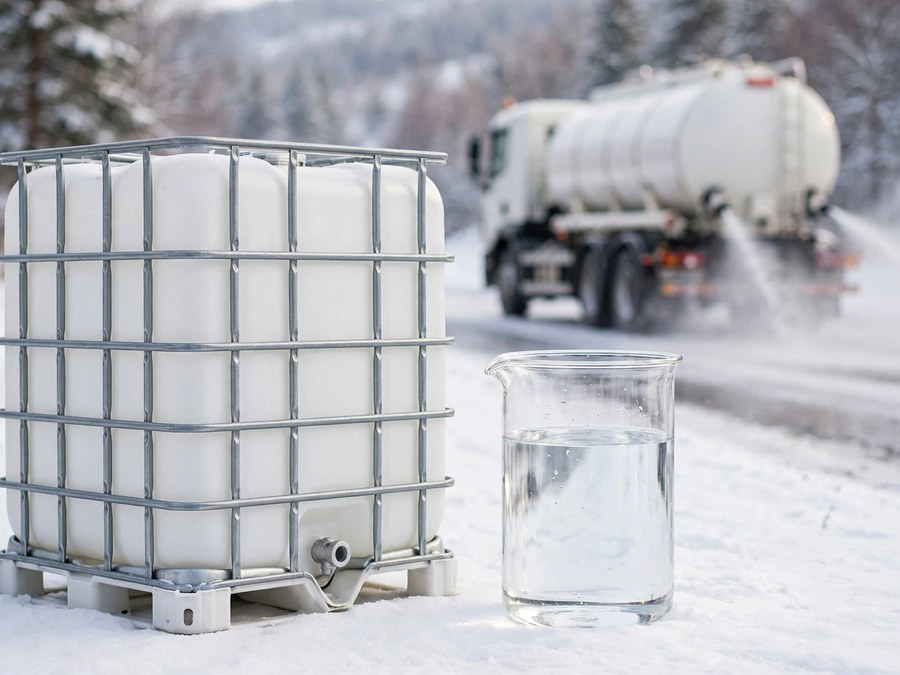
Freeze point at or below −46 °C with a corrosion inhibitor package. Supplied bulk, drums or IBC. Product page →
If you mix your own brine rather than buying it ready-made, the feedstock is the raw magnesium chloride. Product page →
Pre-wetting costs money and needs tanks, pumps and a fleet that can be bothered. It pays back where bounce loss is high — high-speed routes, dry cold roads, coarse salt. On a slow urban route with a sheltered surface, the payback is thinner. Ask your fleet engineer before you buy the equipment, not after.
We answer with an FOB Qingdao price for that one item — not a catalogue. Trial lots from one tonne, around 27 tonnes per 20′ container.
It has to stay liquid at the temperatures your fleet actually works in. HB-L is specified at or below −46 °C, which covers northern winters comfortably.
Yes, and it is often cheaper. You need a mixing setup and a way to check concentration.
No. It reduces how much granular salt you waste, and anti-icing reduces how much you need. The two together change the spread rate; they do not remove the need for product.