For the surfaces where the structure itself is the asset at risk: prestressed concrete, structural steel, listed stonework, and any deck where an inspection would find the damage years later.

| MgCl₂·6H₂O | 95% |
| Corrosion inhibitor | 5% |
| Total | 100% |
| Form | Flake or granular |
| Application rate | 15–100 g/m² |
| Packing | 25 kg PP woven, PE or self-sealing bag; 1,000 kg jumbo bag on ISPM 15 pallet |
| Loading | Approx. 27 t per 20′ container |
| Minimum trial | 1 t |
| Incoterm / HS | FOB Qingdao | 28273100 |
Typical values. The figures for your shipment are stated on the batch certificate.
Most de-icing decisions are made on cost per tonne and how fast the ice goes. A small number are made on what the salt does to the thing underneath it.
A bridge deck, a multistorey car park, a listed facade, a rail platform: the cost of a repair is not measured against the cost of salt. For those sites, HB-3 removes the calcium component entirely and carries the highest magnesium share in the range with a full 5% inhibitor package.
It is the grade we quote when a specification has been written around corrosion rather than around melting speed.
HB-3 is not the fastest-working product we supply, and it is not the cheapest per tonne. If your site is a yard in an industrial estate, HB-1 or plain treated rock salt will do the job for less. We would rather say so than sell you a specification you do not need.
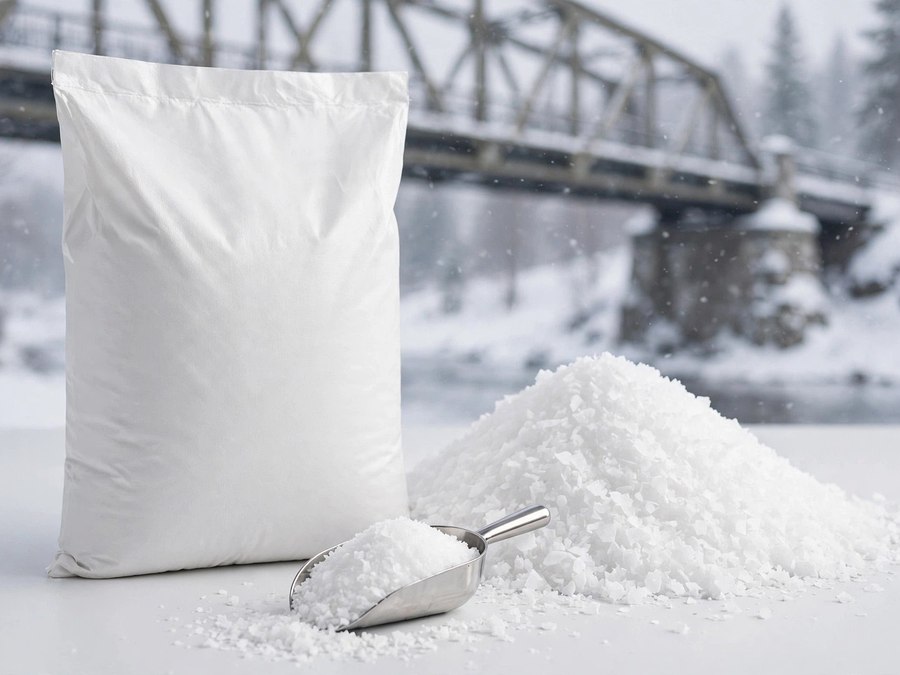
Decks and expansion joints where chloride ingress is the long-term risk.
Networks with a formal corrosion-control requirement in the winter specification.
Structural steel, prestressed elements and heritage stonework.
Corrosion testing is specific to the test method, the concentration and the metal. We quote the inhibitor content in the blend and let your own specification and test method decide whether it meets your requirement — we are not going to hand you a corrosion rate from a test we did not run.
We answer with an FOB Qingdao price for that one item — not a catalogue. Trial lots from one tonne, around 27 tonnes per 20′ container.
No. It is a chloride de-icer with a corrosion inhibitor package. If your specification requires a chloride-free product, that is a different chemistry and we will say so rather than stretch this one.
Calcium chloride is the more aggressive of the two toward steel and concrete. Removing it is what buys the lower-corrosion positioning, at the cost of some melting speed.
Yes — a trial lot from one tonne, which is enough to run your test protocol and enough to be meaningful.